Can You Eat Your Way to Healthier Hair?
A little note before we start…
As a hairdresser and colour specialist, I’ve spent years looking at hair from the outside — how to make it stronger, shinier, healthier and, of course, beautiful.
But what I’ve become increasingly interested in is what’s happening before the hair even reaches the salon chair.
So, in this series I’m going to be looking at the relationship between what we eat and the health of our hair. I’m not a doctor or dietitian, so this isn’t about diagnosing or treating hair loss. Instead, I’ve been looking at established nutritional guidance and published research and translating it into something we can actually use in everyday life.
Hair loss can happen for lots of different reasons and nutrition is only one part of a much bigger picture. If you’re experiencing sudden, significant or unexplained hair loss, I’d always recommend speaking to a qualified trichologist or your GP.
Now, let’s talk about food…
Can we really eat our way to better hair?
We’re very good at thinking about what we put on our hair.
Shampoo. Conditioner. Masks. Oils. Treatments. And believe me, I’m never going to tell you to stop using those!
But lately I’ve been thinking much more about the hair that hasn’t grown yet.
Because by the time I see your hair in my chair, that strand has already been made. We can condition it, protect it, colour it carefully and make it look beautiful — but the actual growing happens underneath the skin, inside the hair follicle.
And those follicles need feeding too.
So does eating well actually make your hair grow?
Yes… but it’s not quite as simple as Instagram would have us believe.
There isn’t one magical food, vitamin or supplement that’s suddenly going to give everyone thick, glossy hair. Genetics play a huge part, and hormones, age, stress, illness and medication can all affect our hair too.
But our bodies do need the right raw materials to produce healthy hair.
And that’s where nutrition gets really interesting.
A very quick lesson in how your hair grows
I promise I won’t turn this into a biology lesson!
Every hair on your head goes through its own cycle. There’s a growing phase, called anagen, followed by a transition and resting phase before the hair eventually sheds and the cycle begins again.
That’s why finding some hair in your brush or shower is completely normal.
Sometimes something can disrupt that cycle.
Significant illness, stress, rapid weight loss, very restrictive diets and not getting enough of certain nutrients can all potentially contribute to increased shedding. One common form of this is called telogen effluvium.
Interestingly, the shedding doesn’t always happen straight away. It can appear some time after the original trigger, which is why we don’t always make the connection.
So what does our hair actually want us to eat?
Unfortunately, there’s no single “hair food”.
If there were, I’d happily eat it every morning.
Hair is largely made from a protein called keratin, so getting enough protein is an important place to start.
Then there’s iron, which is probably one of the nutrients you’ll hear mentioned most often when we talk about hair and shedding.
Our follicles also rely on nutrients including zinc, vitamin D, B vitamins, vitamin C, selenium and copper, alongside essential fats and, importantly, enough energy from our overall diet.
Over this series we’re going to look at these in much more detail — what they actually do, how much we need and, most importantly, what we can eat to get them.
Because I don’t really want to tell you that you need more zinc.
I want to tell you what you can have for lunch.
That’s what I want this series to be about: understanding the science, then turning it into normal, delicious food that we can actually eat.
More isn’t always better
This was one of the things I found most interesting when I started looking more closely at nutrition and hair.
We’re constantly being marketed supplements promising “hair growth”, often containing huge amounts of different vitamins. It creates the impression that if a little bit is good for our hair, more must be better.
That’s simply not how nutrition works.
If you’re genuinely deficient in something your body needs, correcting that deficiency can be important for your overall health and may also be relevant to your hair.
But if you’re already getting enough, taking enormous amounts doesn’t automatically mean your hair will grow faster.
In fact, too much of certain nutrients can cause problems of its own.
We’ll come back to supplements later in the series — particularly biotin, which seems to have become the celebrity of the hair-vitamin world.
And we need to talk about eating enough
There’s another side to hair nutrition that I think is just as important as vitamins and minerals.
We need to eat enough.
Hair isn’t essential to keeping us alive. If the body is put under significant nutritional stress — through extreme dieting, severe calorie restriction, rapid weight loss or inadequate protein intake — our hair can sometimes be affected.
That doesn’t mean going on a diet automatically makes your hair fall out.
But significant weight loss and restrictive diets are recognised triggers for increased shedding in some people. It’s something I think is particularly relevant at the moment, when weight loss and the way we achieve it are being talked about more than ever
We’ll look at this properly later in the series, but for now I think the important message is that eating for healthy hair isn’t just about what we eat.
It’s also about making sure we’re eating enough.
So… can you eat your way to healthier hair?
Sort of.
I think a better way of looking at it is this:
We can eat in a way that gives our body the best nutritional environment in which to grow healthy hair.
Food can’t change our genetics. A bowl of lentils isn’t going to cure hereditary hair loss, and eating more protein isn’t suddenly going to give everyone twice as much hair.
But our hair follicles still need energy, protein, vitamins and minerals to work normally.
So over the next few articles, we’re going to look at exactly what those are, how much we actually need and which foods can help us get there.
And rather than simply giving you a list of vitamins, I’ll be pairing each article with a recipe that puts what we’ve learned into practice.
Because after nearly two decades of talking about shampoos, conditioners and hair masks, I think it’s time we talked a little more about what’s on our plate.
Your hair doesn’t need feeding — your hair follicles do.
Asparagus, Pesto & Parmesan Folded Omelette
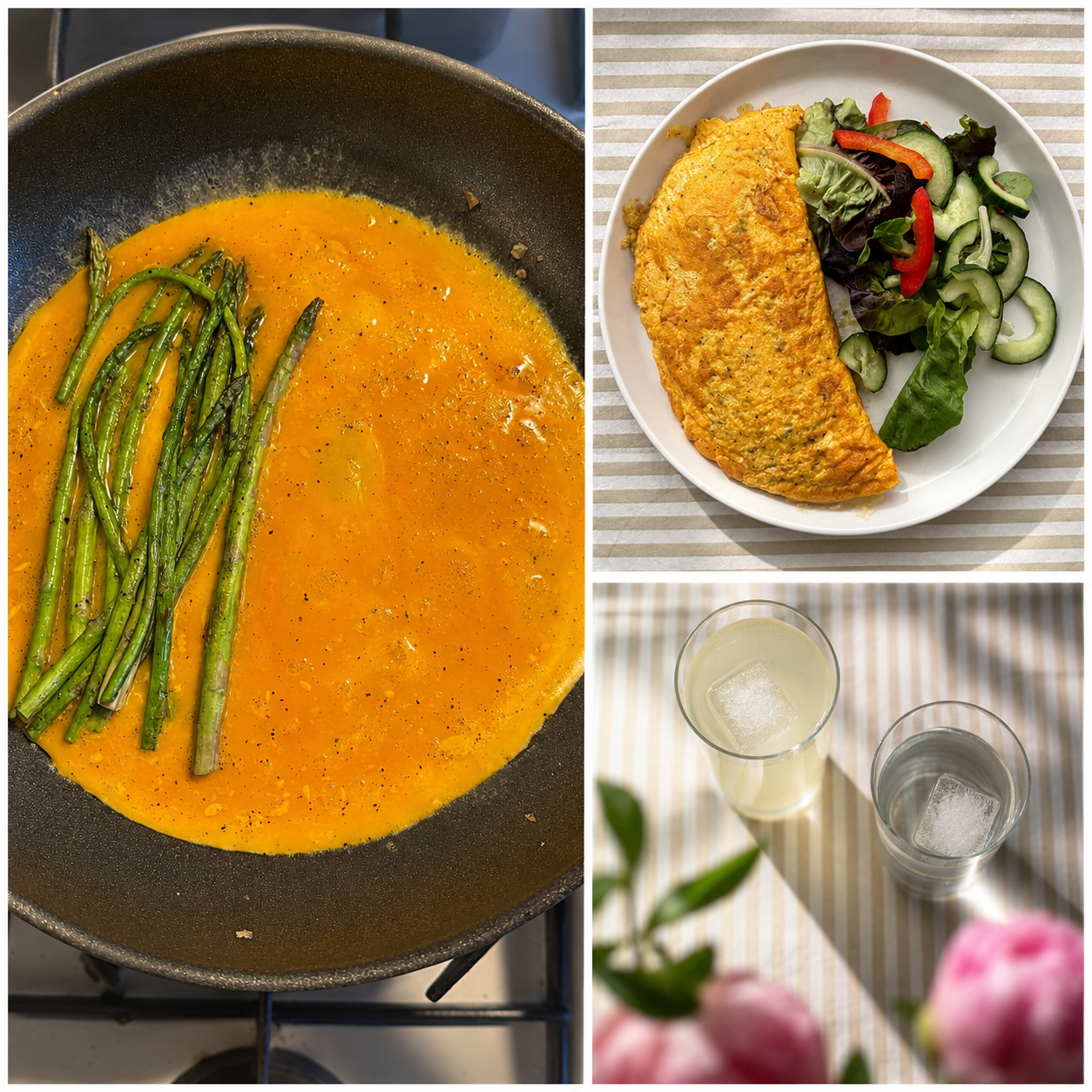
This is such a simple lunch, but one that packs in plenty of the nutrients we’re going to be talking about throughout this series. Eggs give us a great source of protein, alongside nutrients including B12 and selenium, while asparagus provides folate. Add some good olive oil, pesto, Parmesan and fresh greens and you’ve got a delicious lunch that takes hardly any time to make.
Ingredients:
Serves 1
3 eggs
6 fine asparagus spears
1 tbsp pesto
A good glug of olive oil
A handful of grated Parmesan
Salt and freshly ground black pepper
Rocket and spinach, to serve
Method
Heat a frying pan over a medium-high heat with a splash of olive oil. Add the asparagus and cook for around 4–6 minutes, turning occasionally, until lightly charred but still with a bit of crunch.
Remove the asparagus from the pan and set aside. Take the pan off the heat briefly and allow it to cool slightly.
Meanwhile, beat the eggs with a good pinch of salt and pepper.
Return the pan to a medium-low heat and add another small splash of olive oil. Pour in the beaten eggs and allow them to begin to set.
Lay the asparagus over one half of the omelette, spoon the pesto over the asparagus and finish with a generous handful of Parmesan.
Fold the empty half of the omelette over the filling, carefully flip and cook until the egg is completely cooked through and lightly golden on the outside.
Serve straight away with a simple rocket and spinach salad.
Why I love it
It’s quick, filling and made from ingredients you can easily pick up on the way home. More importantly for this series, it combines high-quality protein from the eggs and Parmesan with folate from the asparagus and leafy greens, plus a mixture of fats from the olive oil, pesto and eggs.
No powders, pills or complicated “hair foods” — just a really good lunch.